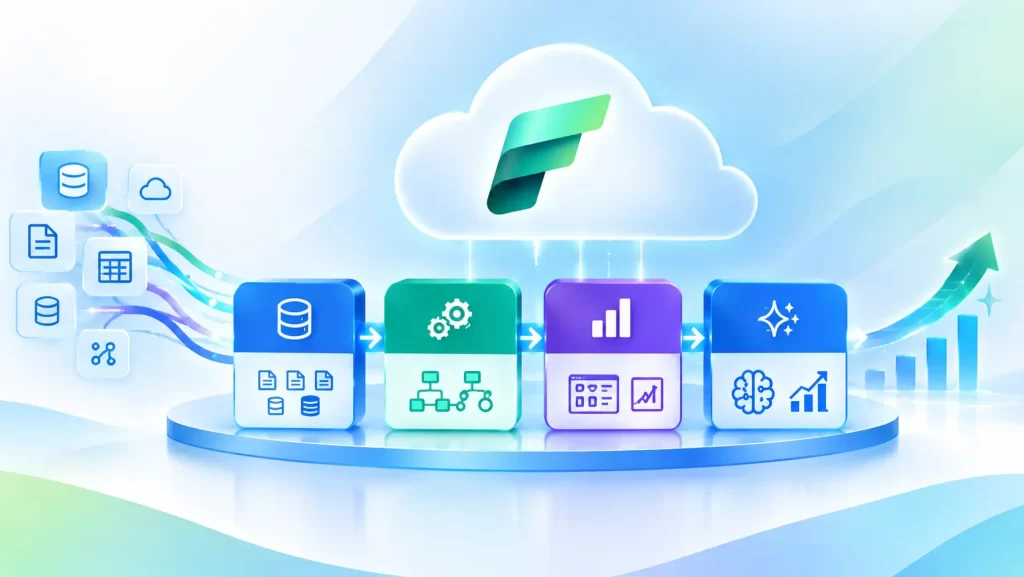
A Fabric implementation should not start with “Which Fabric features should we use?” It should start with “What is happening with the data today?”
1. Start With the Existing Systems
Most businesses already have an ecosystem – Microsoft Dynamics, Salesforce, SQL Server, SharePoint, Excel, websites, custom applications, APIs, or third-party platforms. Replacing everything is rarely necessary; the better approach is usually to connect what already works and improve the parts that don’t.
Nxerra maps these systems first and identifies which data needs to move into the Fabric environment, which should remain in its source system, and which information actually needs to be available for analytics. This keeps the architecture practical.
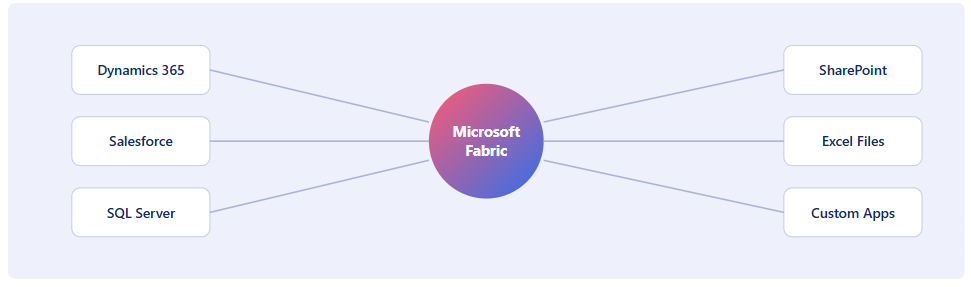
Mapping the existing ecosystem before deciding what moves into Fabric.
2. Build the Data Foundation
Once the sources are understood, the next step is creating a reliable path for the data. This may involve:
3. Create a Single View of Important Business Data
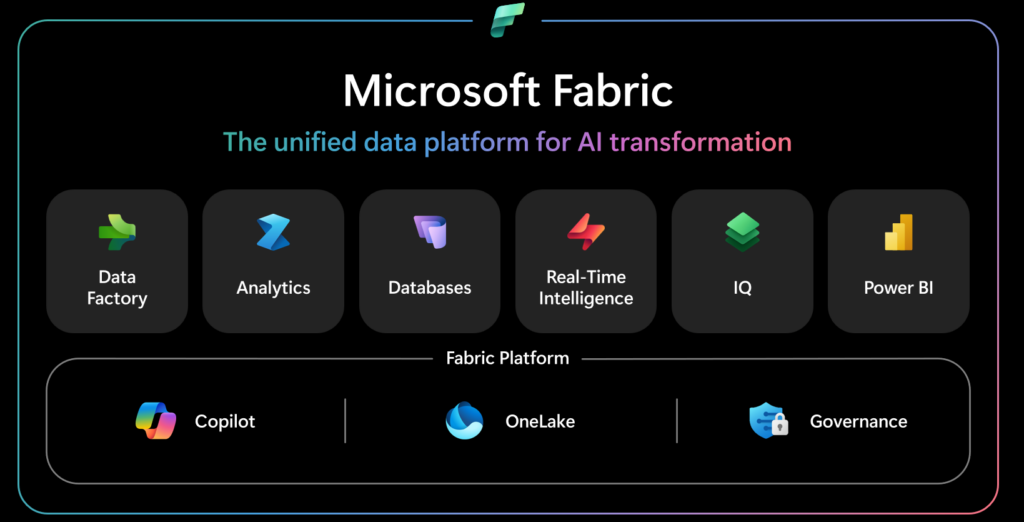
One of the biggest problems we see is multiple versions of the same information. Sales may define an “active customer” one way, Finance another, and Marketing a third. The technology isn’t the problem – the definition is.
A good Fabric implementation needs a clear business model around important entities such as:
- Customers, Products, Orders, Revenue
- Locations, Employees, Suppliers, Contracts
Once those definitions are agreed upon, the data model becomes far more useful – Power BI reports can be built around the same underlying logic rather than every department creating its own interpretation.
A dashboard is only useful if somebody does something with what it shows. The goal is to move from “here is the problem” to “here is the problem, and here is what needs to happen next.”
From Reporting to Business Decisions
A sales dashboard may identify declining revenue in a region, triggering an investigation. An inventory model may flag products approaching a stock-out, triggering replenishment. A customer analysis may spot reduced engagement, triggering an account-management action. This is where Fabric becomes part of a broader Microsoft ecosystem – connecting Fabric, Power BI, Power Automate, Power Apps and AI so that analysis connects to action.
Adding AI to the Data Platform
AI is a major reason businesses are investing in better data architecture – but AI does not make bad business data good. Duplicated customer records, inconsistent financials, and data trapped across disconnected systems don’t get solved by adding an AI layer on top; they can become harder to detect. A stronger approach is:
Once the underlying data is trustworthy, AI becomes genuinely useful — for natural-language analysis, forecasting, customer segmentation, anomaly detection, document analysis, operational intelligence, automated reporting, and business process automation. The specific use case matters more than simply being “AI-ready.”
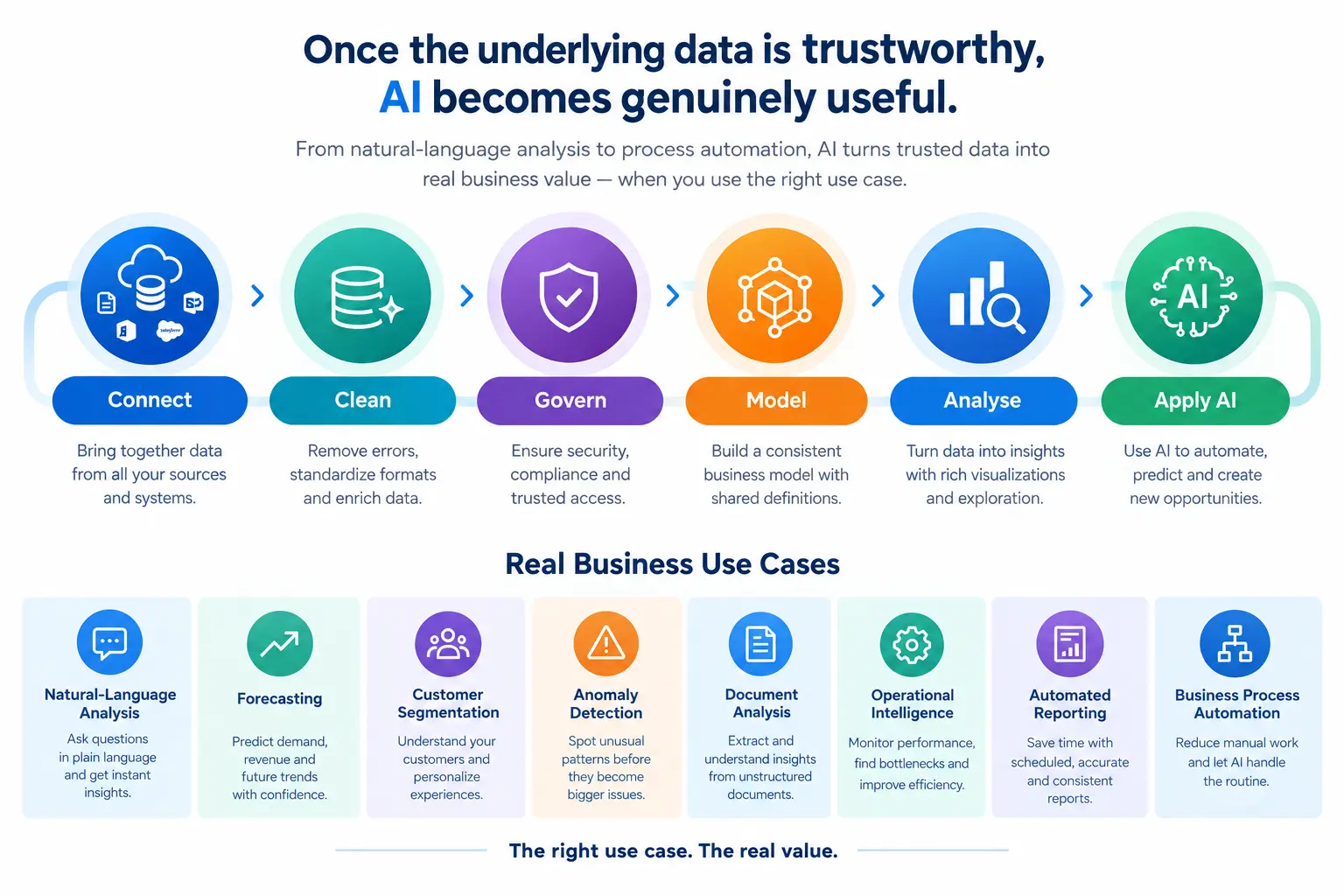
AI performs best once the pipeline in front of it is trustworthy.
- Security by design: Access, identity, governance and monitoring are considered while the architecture is designed – not bolted on afterward.
- Capacity planning: Data volumes, refresh frequency, concurrency and growth are planned together so capacity isn’t over- or under-bought.
Security Is Part of the Architecture
Data consolidation raises an important question: who should be able to see what? A sales manager may need regional sales data; Finance needs financial data; HR shouldn’t automatically see sales or customer information. For organisations already using Microsoft Entra ID, Microsoft 365 and Microsoft security services, Fabric can fit into a broader Microsoft security and governance strategy.
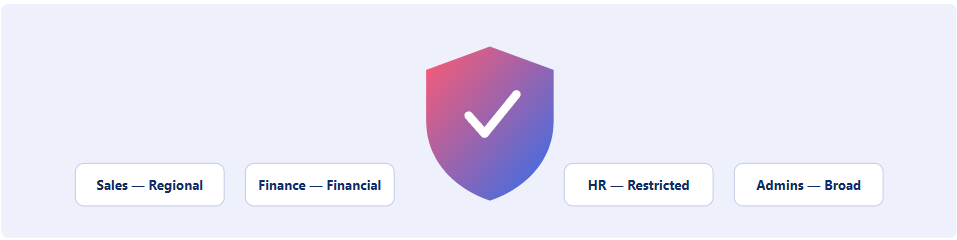
Access follows role – designed in from the start, not added at the end.
Cost Matters Too
A technically impressive architecture that becomes unnecessarily expensive isn’t a good architecture. Fabric capacity is shared across workloads, so data engineering, warehousing and analytics need to be planned together. At Nxerra, we look at data volumes, refresh frequency, query patterns, concurrent users, processing requirements, storage, capacity utilisation and growth expectations — the goal is an environment that handles the workload without paying for infrastructure the business doesn’t need.
A Fabric Architecture Should Grow With the Business
A company may start with a few data sources and a year later have more customers, transactions, applications, reports, users, automation and new AI requirements. That’s why we design Fabric environments with clear separation between raw, refined and business-ready data, appropriate governance, reusable pipelines and well-defined semantic models. The goal is simple: build something that works today without creating tomorrow’s problem.
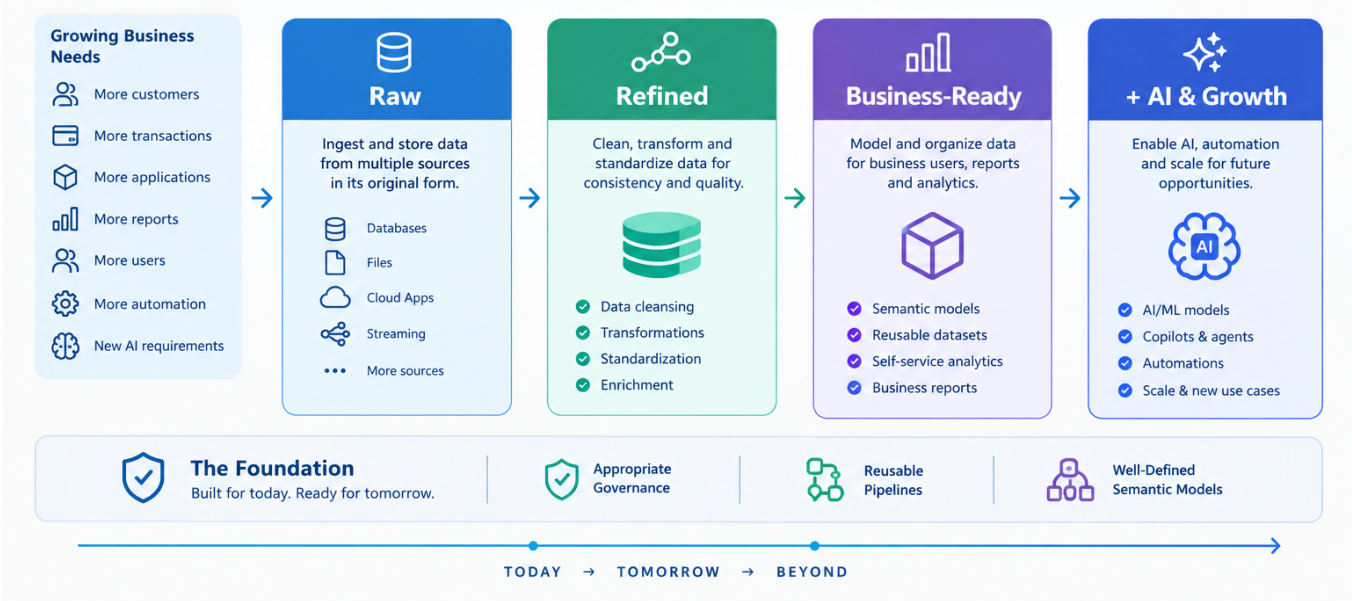
Layered separation gives the architecture room to grow.
Where Microsoft Fabric Fits Into the Bigger Picture
Fabric doesn’t need to exist as a standalone technology project. For many Microsoft-focused organisations, it becomes part of a broader architecture – Dynamics 365 for business transactions, Salesforce or another CRM for customer information, Azure for applications and integration, Fabric/OneLake as the unified data foundation, Power BI for business intelligence, Power Platform for automation, Microsoft Security/Entra ID for identity and access, and AI for intelligence and automation on top. The connection between these systems is where the architecture starts creating value.
Why Nxerra Looks at Fabric Differently
We don’t approach Fabric as a standalone analytics product. Our broader Microsoft practice covers Azure, Dynamics 365, Power Platform, Microsoft 365, Microsoft Security and custom application development — which gives us a different starting point: we look at the systems surrounding the data, not only the data platform itself.
If an old application is creating data problems, the answer may involve the application. If it’s an integration problem, Azure may be part of the solution. If it’s manual work after reporting, Power Automate or Power Platform may be appropriate. If business data is inconsistent, the first priority may be data modelling and governance. And once the data foundation is ready, AI may finally make sense. The technology should follow the problem — not the other way around.
The Bottom Line
Microsoft Fabric can bring a large part of the modern data lifecycle into one environment, but the platform itself is not the outcome. The outcome is having data that people can find, understand, trust and use — whether that means replacing fragmented reporting, connecting ERP, CRM and operational systems, building the foundation for AI, or sometimes, not implementing Fabric at all.
That’s why the first step should always be understanding the business and its existing technology landscape. Good data architecture isn’t about having more technology — it’s about having fewer disconnected problems.
How Nxerra Can Help
Nxerra Technologies helps businesses design and implement Microsoft-based technology solutions across Microsoft Fabric, Azure, Power BI, Power Platform, Dynamics 365, Microsoft 365, Microsoft Security, and Custom Software & AI. From connecting existing systems to building a modern data platform, our focus is on creating technology that works with the way the business actually operates.
If your organisation is considering Microsoft Fabric, the first conversation shouldn’t be about which features to buy – it should be about what’s currently making your data difficult to use, and what the architecture needs to change.